
![]() |
![]() |
|
|
|
|
JAMA Study on Routine Episiotomy
Katherine Hartmann and colleagues have published a new systematic review about effects of routine episiotomy on women. It is important for pregnant women and their caregivers to understand lessons from this research, detailed below. Please see also Childbirth Connection's clear, simple advice for pregnant women on how to avoid routine episiotomy. What did the new episiotomy study do?The new study used a rigorous systematic review approach to summarize the best available research about effects of routine episiotomy on mothers. Episiotomy is a surgical cut that is often made just before birth to enlarge the opening of the vagina. This practice has been widely used for many decades in the belief that it offers benefits to mothers.What did the researchers conclude?The researchers found that routine episiotomy offers mothers no benefits and is associated with harms.Depending on the circumstances, the literature reviewed found that routine episiotomy increased:
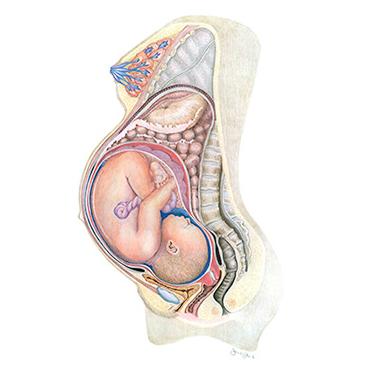
Midline episiotomy, the standard in North America, is a cut straight back into the perineum (see pelvic floor and episiotomy pictures below, or find more information on the effect of episiotomy on the pelvic floor). With this type of cut, women are vulnerable to tissue tears that extend into or through the anal muscle. Pelvic Floor Anatomy �1981 Sheila Kitzinger and National Childbirth Trust. Used with permission. Episiotomy Technique �1981 Sheila Kitzinger and National Childbirth Trust. Used with permission. What are some concerns about tears that extend into or through the anal muscle?This type of trauma increases women's risk of harm due to
Are concerns about effects of routine episiotomy new?No. The evidence has been clear and consistent for many years. Numerous past reviews have come to similar conclusions.Why are so many episiotomies being performed on women when the best research has shown that they are harmful?Despite compelling research evidence, many maternity care providers still use this procedure liberally. This happens for many reasons. These include:
How often are episiotomies used with vaginal birth?The episiotomy rate has been falling off for some time in the U.S. However, when Childbirth Connection carried out its national U.S. Listening to Mothers survey among women who had given birth from 2000 to 2002, 35% of mothers with a vaginal birth had experienced episiotomy.Episiotomy rates vary dramatically across providers and hospitals. So, choice of caregiver and choice of birth setting affect a woman's likelihood of this and other labor interventions. What is a good rate of episiotomy?Authors of the JAMA study recommend that the U.S. could immediately achieve a rate below 15% of vaginal births. Providers with a conservative practice style have rates well below 15%. Midwives generally have the lowest rates, followed by family physicians and obstetricians.How can a pregnant woman avoid a routine episiotomy?In this environment, a woman should not assume that she will only get an episiotomy if it is necessary. Apart from an urgent need to hasten a birth, there is no clear justification for episiotomy. Childbirth Connection has gathered tips to help women avoid routine or unnecessary episiotomies.Is episiotomy a factor in the supposed "harms of vaginal birth"?Episiotomy is just one of the practices that contribute to the supposed "harms of vaginal birth". Research has identified concerns about other practices that may be widely used with vaginal birth. In addition to episiotomy, other practices that appear to increase risk of harm to the pelvic floor include pushing and giving birth on the back, forceful staff-directed pushing, use of forceps or vacuum extraction, pressing on the abdomen (by a staff member) during pushing, and epidural analgesia. Use of these practices could be greatly reduced, to the benefit of birthing women.There is growing talk among professionals and in the media about supposed hazards of vaginal birth. In a large review of the best science, Childbirth Connection did not find a single study that minimized harmful management practices to try to understand whether vaginal birth in itself poses harm. It is wrong at this time to conclude that vaginal birth is harmful. Due to many increased harms associated with major surgery, an appropriate solution is to improve the way providers manage vaginal birth rather than shifting to cesarean section without medical need. ReferencesHartmann K, Viswanathan M, Palmieri R, Gertlehner G, Thorp J, Lohr KN. Outcomes of routine episiotomy: a systematic review.JAMA 2005;293:2141-8.Viswanathan M, Hartmann K, Palmieri R., Lux L, Swinson T, Lohr KN, Gartlehner G, Thorp J. The use of episiotomy in obstetrical care: a systematic review; summary. Agency for Healthcare Research and Quality (Evidence Report/Technology Assessment: Number 112.) University of North Carolina, Center for Women's Health Research. Routine episiotomy does not provide benefits: the importance of asking questions about common things. Most recent page update: 6/30/2008
© 2010 Childbirth Connection. All rights reserved.
Childbirth Connection is a national not-for-profit organization founded in 1918 as Maternity Center Association. Our mission is to improve the quality of maternity care through research, education, advocacy and policy. Childbirth Connection promotes safe, effective and satisfying evidence-based maternity care and is a voice for the needs and interests of childbearing families. |
News and Features
"2020 Vision" and "Blueprint for Action" Reports Available
Rising Maternal Mortality
Maternity Care Fact Sheet Available
US Cochrane Center (USCC)/Consumers United for Evidence-based Healthcare (CUE) Maternity Care, a Major Segment of Health Industry, Must Be Overhauled for Health Care Reform to Succeed
Help Transform Maternity Care! Please join our efforts to make quality maternity care a top national priority. Your support will help make the transformation possible.View 2009 Supporter Roster ![]() New Mothers Speak Out National Report Released The latest report in Childbirth Connection's Listening to Mothers series is now available. Get an eye-opening look at the reality of life as a mother of young children in the United States, based on national surveys conducted by Harris Interactive. Learn more, get the report Read the Wall Street Journal story and listen to the podcast ![]() Download Quick Facts (PDF) ![]() New Content!
![]() Journey to Parenthood Full Book Available Online! A family-friendly book covering the trimesters, pregnancy resources, and the latest information on baby's first year of development. Available online (free) and for purchase in the Bookstore. Browse through Journey to Parenthood ![]() Buy this book and learn more
Popular Pages
"I feel my doctor put too much stress on me during the later stages of my pregnancy by trying to force me into another c-section."
Every woman has the right to receive full advance information about risks and benefits of all reasonably available methods for relieving pain during labor and birth, including methods that do not require the use of drugs. She has the right to choose which methods will be used and to change her mind at any time.
|