
![]() |
![]() |
|
|
|
|
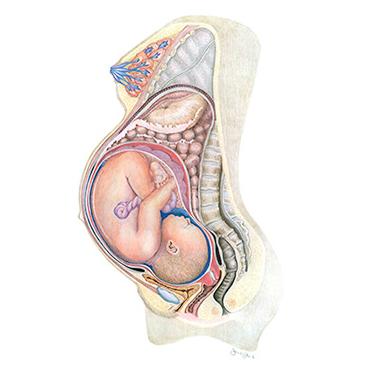
EpisiotomyWhat is an episiotomy? How does having an episiotomy affect my pelvic floor? What is a reasonable episiotomy rate? How can I avoid having an episiotomy? When might episiotomy be recommended? What is an episiotomy?An episiotomy is a cut made in the back of the vagina to enlarge it for birth. With midline or median episiotomy, (the type usual in the U.S. and Canada), the cut is made from the back of the vaginal opening straight toward the anus. With mediolateral episiotomy (the usual type in most of the rest of the world), the cut is made off to one side. See drawings below.Pelvic Floor Anatomy
©1981 Sheila Kitzinger and National Childbirth Trust. Used with permission. Episiotomy Technique
©1981 Sheila Kitzinger and National Childbirth Trust.
Used with permission. How does having an episiotomy affect my pelvic floor?In the past, most care providers believed that episiotomy
would prevent serious tears extending into the anal muscle. Anal muscle
injury is a concern as it can lead to leaking gas, a sense of urgency
about elimination, or even leaking feces (bowel incontinence).
However, a large body of consistent research has shown that liberal or routine use of episiotomy promotes rather than prevents pelvic floor dysfunction. It offers no advantages over the spontaneous tissue tears that may occur during birth. Midline episiotomy (the type that is usual in the U.S. and Canada, see diagram above) increases risk for tears into or through the anal muscle. Nearly all anal muscle tears that occur during birth are extensions of midline episiotomies. Mediolateral episiotomy (the cut is made diagonally off to one side, see diagram above) is usual in most other parts of the world. Although it doesn't seem to cause anal muscle tears, it doesn't prevent them either. Women with no episiotomy have similar low risk for anal muscle tears compared with women with mediolateral episiotomy. This type of incision, however, goes through muscle fibers (see Pelvic Floor Anatomy picture) and can involve a longer, more painful healing period, scarring, and sometimes a scar with uneven healing that pulls to one side. What is a reasonable episiotomy rate?While the percentage of women who give birth vaginally and have episiotomies
has fallen steadily in recent decades in the U.S., it still has far to
go. Currently, about 35 in 100 women with vaginal births have
episiotomies. Episiotomy rates vary widely across caregivers
and across birth settings; studies show that they could safely be much
lower, 7 or fewer in every 100 vaginal births. How can I avoid having an episiotomy?With 1 woman in 3 with a vaginal birth in the U.S. having an episiotomy and much higher rates in many other parts of the world, it is important to understand the practice style of those who might attend your birth. If possible, arrange to receive care from a caregiver (or group of caregivers) with a commitment to restricted use of this procedure. If this is not possible, make it quite clear that you do not want an episiotomy unless there is a medically urgent need to hurry the birth. Tips & Tools: Pelvic Floor will give you additional information on how to avoid episiotomy.)When might episiotomy be recommended?About the only reason most caregivers would agree that an episiotomy is appropriate is when the baby is close to being born and an urgent problem develops.When examined in scientific studies, none of the reasons given for the common or routine use of episiotomy holds up, including:
Most recent page update: 2/21/2006
Related Links
© 2013 Childbirth Connection. All rights reserved.
Childbirth Connection is a national not-for-profit organization founded in 1918 as Maternity Center Association. Our mission is to improve the quality and value of maternity care through consumer engagement and health system transformation. Childbirth Connection promotes safe, effective and satisfying evidence-based maternity care and is a voice for the needs and interests of childbearing families. |
News and Features
Listening to MothersSM III is the third national
survey exploring women’s experiences in pregnancy and childbirth.
Commissioned by Childbirth Connection, conducted by Harris Interactive, and
funded by the W.K. Kellogg Foundation, the survey polled 2,400 women who gave
birth in U.S. hospitals from 2011 to 2012. Results show that medically
intensive experiences are typical, and evidence-based practices are
underutilized. Childbearing women need better support and knowledge to
navigate their maternity care.
Access the full report and supplementary materials ![]() New Report: Maternity Care and Liability Go to report and supporting materials ![]() New Report: The Cost of Having a Baby in the United States Go to report and supporting materials ![]() New Cesarean Resources: Go to Best Evidence Report ![]() Go to web pages and booklet for women ![]()
For 95 years, Childbirth Connection has been dedicated to improving the
quality and value of maternity care for all women and their families. Learn
more about our rich history through our interactive
timeline and give
$95 for 95 in honor of
our 95th birthday.
Childbirth Connection works to ensure that all women and babies get the best
possible maternity care. We have the collective vision and we know how to get
there, but we can't do it alone. Join the transformation
today.
The Transforming
Maternity Care website focuses on maternity care
system improvements designed to engage diverse stakeholders in quality
improvement efforts. The site offers full access to the landmark reports 2020 Vision and
Blueprint for
Action, features a Blog, and other
resources such as an Action Center, a
database of
quality improvement projects, an interactive data
center, and many more tools
for advocates and stakeholders.
Help Transform Maternity Care! |