
![]() |
![]() |
|
|
|
|
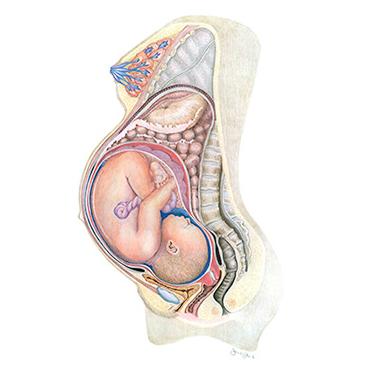
Picture of Your Body Before Pregnancy
Below the diaphragm is the left side of the liver, above and in front of the stomach. In this cross-section, the descending colon, small intestine, transverse colon, and stomach hide the gall bladder, ascending colon, and portions of the liver and small intestine in the right side. The ribs are visible beneath the right breast. The symphysis, coccyx, sacrum, some vertebrae, and the spinal canal are also shown. Behind the symphsis are the bladder and the urethra, which extends from the neck of the bladder to the urinary opening in the vestibule of the vulva. In front of this opening is the clitoris. Behind the bladder and urethra is the vagina. The uterus, in its normal position, is above and behind the bladder, with its cervix protruding into the vagina. The pelvic colon, rectum and anal canal are behind the vagina and uterus. The individual organs accommodate themselves to the changing conditions of those that surround them and to the size and shape of the body cavity. The configuration of the bony framework and the tone of the muscle walls - determined by heredity, age, nutrition, disease, injury, and habitual posture - control the size and shape of the body cavity. Buy The Growing Uterus Chart Set in Our BookstoreThis picture is sold as part of a set of 7 charts in the Growing Uterus Charts available in our Bookstore. To buy the set, click here for more details.Most recent page update: 4/17/2008
© 2013 Childbirth Connection. All rights reserved.
Childbirth Connection is a national not-for-profit organization founded in 1918 as Maternity Center Association. Our mission is to improve the quality and value of maternity care through consumer engagement and health system transformation. Childbirth Connection promotes safe, effective and satisfying evidence-based maternity care and is a voice for the needs and interests of childbearing families. |
News and Features
Listening to MothersSM III is the third national
survey exploring women’s experiences in pregnancy and childbirth.
Commissioned by Childbirth Connection, conducted by Harris Interactive, and
funded by the W.K. Kellogg Foundation, the survey polled 2,400 women who gave
birth in U.S. hospitals from 2011 to 2012. Results show that medically
intensive experiences are typical, and evidence-based practices are
underutilized. Childbearing women need better support and knowledge to
navigate their maternity care.
Access the full report and supplementary materials ![]() New Report: Maternity Care and Liability Go to report and supporting materials ![]() New Report: The Cost of Having a Baby in the United States Go to report and supporting materials ![]() New Cesarean Resources: Go to Best Evidence Report ![]() Go to web pages and booklet for women ![]()
For 95 years, Childbirth Connection has been dedicated to improving the
quality and value of maternity care for all women and their families. Learn
more about our rich history through our interactive
timeline and give
$95 for 95 in honor of
our 95th birthday.
Childbirth Connection works to ensure that all women and babies get the best
possible maternity care. We have the collective vision and we know how to get
there, but we can't do it alone. Join the transformation
today.
The Transforming
Maternity Care website focuses on maternity care
system improvements designed to engage diverse stakeholders in quality
improvement efforts. The site offers full access to the landmark reports 2020 Vision and
Blueprint for
Action, features a Blog, and other
resources such as an Action Center, a
database of
quality improvement projects, an interactive data
center, and many more tools
for advocates and stakeholders.
Help Transform Maternity Care! |