
|
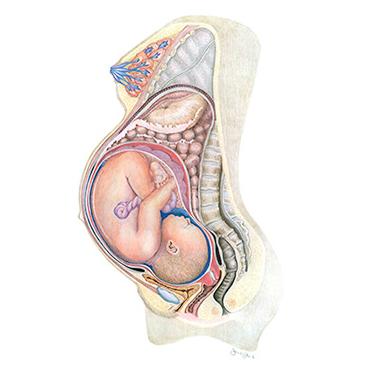
Picture and Explanation of How Your Baby is Growing and Developing at 36 Weeks Pregnant
By
the end of the 36th week of pregnancy, the enlarged uterus almost fills
the abdominal cavity, despite the fact that the cavity is greatly
expanded by the stretching of its front and side walls. The
well-developed, plump baby, in the membranous sac within the uterus,
lies wholly within the abdominal cavity, with the abdominal muscles
supporting much of its weight. During this week, the fundus is at the
tip of the xiphoid cartilage of the breastbone, which is shown pushed
forward. The liver, transverse colon, stomach, and spleen (which is
behind the upper portion of the stomach) are crowded into the vault of
the abdominal cavity. The small intestines are crowded above, behind,
and to the sides of the uterus. The diaphragm is pressed upward,
reducing the vertical diameter of the chest cavity sometimes as much as
4 centimeters; to compensate, the space on the side, front, and back of
this cavity increases. The capacity of the chest cavity is not
diminished. This displacement of the diaphragm changes the position of
the heart, and the increased blood volume may cause the heart to dilate
slightly.
Although there is an increase in the amount of blood pumped from the
heart per minute and in the amount of air respired per minute, the
change in the position of the heart and the upward pressure of the
diaphragm probably account for the difficult breathing and the
smothered feeling you may experience during this week. The crowding of
the stomach and intestines contributes to the discomfort after eating.
The cervix is long, thick, and filled with the mucous plug. By the 36th
week, the vagina and urethra are elongated and all the tissues in the
perineal region are enlarged, so the swollen perineum projects beyond
the pelvic outlet in the last weeks of pregnancy, and is readily
expandable during labor.
This picture is sold as part of a set of 7 charts in the Growing Uterus Charts available in our Bookstore. To buy the set, click here for more details.
Most recent page update: 11/7/2007
© 2010 Childbirth Connection. All rights reserved.
Childbirth Connection is a national not-for-profit organization founded in 1918 as Maternity Center Association. Our mission is to improve the quality of maternity care through research, education, advocacy and policy. Childbirth Connection promotes safe, effective and satisfying evidence-based maternity care and is a voice for the needs and interests of childbearing families.
|
News and Features
"2020 Vision" and "Blueprint for Action" Reports Available Leaders from across the U.S. health care system have prepared several reports for improving the maternity care system. Learn about Transforming Maternity Care project  Read the "2020 Vision"  Read the "Blueprint for Action"  Read the Consumer Workgroup report  Help implement Blueprint recommendations 
Rising Maternal Mortality Analysis of maternal mortality data for the state of California, with 14% of the nation's births, strongly suggests that maternal mortality is increasing in tandem with rising rates of cesarean section and obesity. Read article about maternal mortality in California  Read companion Q&A 
Maternity Care Fact Sheet Available A new fact sheet (12/09) summarizes U.S. maternity care trends and figures from the latest federal reports. The fact sheet updates background information in the 2008 Milbank Report on Evidence-Based Maternity Care. Get the fact sheet  Read Evidence-Based Maternity Care 
US Cochrane Center (USCC)/Consumers United for Evidence-based Healthcare (CUE) Visit the USCC/CUE website for the latest pregnancy and childbirth systematic reviews. 
Maternity Care, a Major Segment of Health Industry, Must Be Overhauled for Health Care Reform to Succeed As competing interests work out the particulars of health care reform, Childbirth Connection reminds the nation that rapid gains in the quality, cost, and value of maternity care are achievable. Read the press release (PDF) 
National Policy Symposium Honors Childbirth Connection's 90th Anniversary Nearly 250 leaders deliberated about Transforming Maternity Care in Washington DC in April 2009. Learn about symposium, next steps  See 90 years of milestones for women and families (PDF) 
Seton Family of Hospitals Receives First Maternity Quality Matters Award Childbirth Connection presented its inaugural Maternity Quality Matters Award to an organization that is achieving significant gains for women and newborns. Learn more about award winner 
Maternity Care Priorities in Health Care Reform Childbirth Connection has issued a statement about health care reform priorities for a high quality, high value maternity care system. Read the statement (PDF) 
Evidence-Based Maternity Care Report Released A major new report takes stock of the U.S. maternity care system and finds great opportunities for improvement. Childbirth Connection collaborated with the Reforming States Group and the Milbank Memorial Fund to develop the report. Learn more, get the report  Read companion USA Today article  Read the USA Today article  Read the Consumer Reports story  Take the Consumer Reports quiz Read Our Bodies Our Blog entry 
Help Transform Maternity Care! Please join our efforts to make quality maternity care a top national priority. Your support will help make the transformation possible. View 2009 Supporter Roster  New Mothers Speak Out National Report ReleasedThe latest report in Childbirth Connection's Listening to Mothers series is now available. Get an eye-opening look at the reality of life as a mother of young children in the United States, based on national surveys conducted by Harris Interactive. Learn more, get the report Read the Wall Street Journal story and listen to the podcast Download Quick Facts (PDF) 
"My biggest piece of advice to a mother that is pregnant for the first time is: feel comfortable with your doctor or midwife. And it's definitely ok to change, even at the last minute!"
-Listening to Mothers® survey participant
Every woman has the right to decide collaboratively with caregivers when she and her baby will leave the birth site for home, based on their condition and circumstances.
|