
![]() |
![]() |
|
|
|
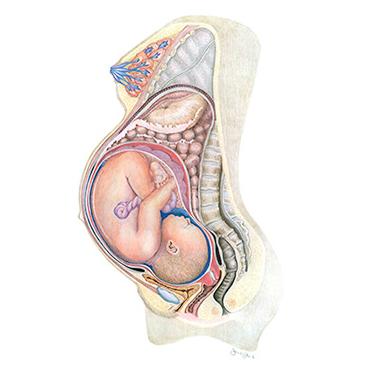
Picture and Explanation of How Your Baby is Growing and Developing at 40 Weeks Pregnant (at term)
The elongated and enlarged round ligament is shown in this picture with its uterine attachment far below the fundus and separated from the broad ligament by the expansion of the uterine wall. It is also farther forward because of the twisting of the uterus. The enlarged uterosacral ligament is shown stretched taut by the enlarged uterus. Backaches in late pregnancy may be due to the stress of the weight of the uterus on the uterosacral ligaments attached to the spine. The descent of the uterus explains the easier breathing during the latter weeks of pregnancy, the comparative comfort after eating, and partial relief from the smothered feeling. The uterine ligaments undergo prolonged stretching during pregnancy. After delivery, adequate rest is essential to permit the ligaments to regain the elasticity and tone, which they must have to hold the uterus in good position. Buy 40 Weeks Pregnant At Term (External) in Our BookstoreThis picture is sold as part of a set of 7 charts in the Growing Uterus Charts available in our Bookstore. To buy the set, click here for more details.Most recent page update: 11/7/2007
Related Links
© 2010 Childbirth Connection. All rights reserved.
Childbirth Connection is a national not-for-profit organization founded in 1918 as Maternity Center Association. Our mission is to improve the quality of maternity care through research, education, advocacy and policy. Childbirth Connection promotes safe, effective and satisfying evidence-based maternity care and is a voice for the needs and interests of childbearing families. |
News and Features : Health Professionals
New VBAC Guidlines
ACOG has just issued new Guidlines for VBAC. What changed? What continues? We've Moved!
On July 1, 2010, the Childbirth Connection office moved to 260 Madison Avenue, 8th Floor, New York, NY 10016. All other contact information is unchanged. "2020 Vision" and "Blueprint for Action" Reports Available
Rising Maternal Mortality
Help Transform Maternity Care! Please join our efforts to make quality maternity care a top national priority. Your support will help make the transformation possible. View 2010 Supporter Roster
Updated Maternity Care Statistics Available
US Cochrane Center (USCC)/Consumers United for Evidence-based Healthcare (CUE)
New Mothers Speak Out National Report Released The latest report in Childbirth Connection's Listening to Mothers series is now available. Get an eye-opening look at the reality of life as a mother of young children in the United States, based on national surveys conducted by Harris Interactive. Learn more, get the report Read the Wall Street Journal story and listen to the podcast ![]() Download Quick Facts (PDF) ![]() Why does the national U.S. c-section rate keep going up? Current research points to an optimal cesarean section rate of 5% to 10%, but 1 pregnant woman in 3 is giving birth by major surgery in the United States. Why the surge and is this safe? A new page - and a PDF handout for journalists, policy makers, students and others - answer these questions. Read more about the rising cesarean section rate ![]() New Content!
March/April 2009 evidence column is now available.
Features: National Quality Forum endorses consensus perinatal performance measures; systematic reviews on induction of labor, environmental tobacco smoke and fetal health, and HPV infection and cervical neoplasia Get the column ![]() Popular Pages
![]() Comfort in Labor, by Penny Simkin Penny Simkin, the internationally recognized leader in childbirth education and labor support, shares her wisdom with women, including comfort measures, effective positions, and tips for partners and doulas. Download Comfort in Labor (free PDF)
Every woman has the right to receive maternity care that identifies and addresses social and behavioral factors that affect her health and that of her baby. She should receive information to help her take the best care of herself and her baby and have access to social services and behavioral change programs that could contribute to their health.
|