
Send to a Friend   Printer Friendly     

Your Body in the First Trimester of Pregnancy


During the first 14 weeks of pregnancy, your body will begin to undergo a dramatic change as it begins to support your growing baby.

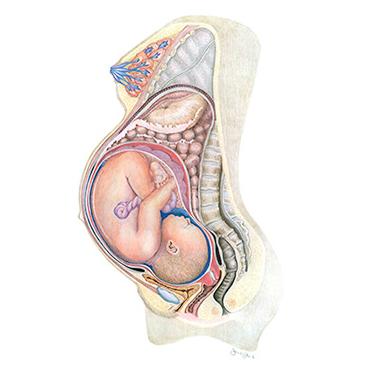
pregnant body first trimester, 12 weeks pregnant
view larger picture of 12 weeks pregnant diagramview larger picture
12 weeks pregnant picture

Source: The Growing Uterus Charts,
© 1989, 2006 Childbirth Connection


  • The uterus (the hollow, muscular organ that supports growth and development for the fetus) will begin to increase in size to hold your growing fetus. You may feel strong twinges (known as round ligament pains) on either side of your belly as the uterus grows.
  • The bladder is compressed by the growing uterus. You may feel the need to urinate more frequently.
  • The muscles in the bowel relax due to the increasing flow of certain pregnancy hormones, and the growing uterus begins to place pressure on the bowel. Digestion slows down and this may cause constipation, heartburn, and gas. Increasing your intake of liquids and eating extra fiber can be helpful.
  • In the cervix (the neck of the uterus), glands begin to release thick mucus that forms a structure called the mucus plug. This plug seals the canal that leads to the inside of the uterus in order to prevent infection.
  • Your breathing and pulse rates increase.
  • Your breasts begin to swell and feel fuller and tender to the touch. The nipples and areola (the pigmented area surrounding the nipples) will begin to darken, and the sweat glands that are found around the areola seem larger (like goose bumps). You'll probably notice the veins in your breasts more than usual; this is because the blood supply to them is increasing.
  • Your metabolism (the mechanical changes in your body that control digestion, elimination, breathing, and energy) will speed up. Around the third month, you may begin to notice an increase in your appetite. You may feel warmer than usual.
  • The changes in your body may also cause you to feel nauseated or to vomit. Although this is sometimes called "morning sickness", it can occur at any time of day. It usually goes away by the 12th week of pregnancy. Talk to your health care provider about what you can do to feel better.
  • You may have less energy and will probably feel an increased need for sleep. Take naps as often as you can.
  • You will probably experience mood changes. You may feel less in control of your feelings and may sometimes have mixed feelings about being pregnant.

Your Emotions

Pregnancy and birth are major events. It's perfectly normal to feel happy one minute and moody or sad the next. However, a small number of pregnant women experience a depression serious enough to require professional attention. If you are concerned about feeling blue, talk to your health care provider or get a referral to a mental health professional. You can contact your insurance carrier to find out how to connect with behavioral health providers directly and confidentially.

Physical and emotional stresses are part of everyday life and are usually manageable. Many factors can contribute to stress in pregnancy such as the changes your body is going through, possible changes in your relationships with your partner, co-workers, and family, and financial concerns. It's possible that too much stress can contribute to prematurity and low birth weight of the baby.

Learning to manage stress will help you and your partner avoid habits that can harm you and the baby, like drinking alcohol, smoking cigarettes, or using illicit drugs. 

Here are just a few ways to help you handle stress in pregnancy (and parenthood):
  • Recognize the things that cause you stress, and try to avoid them.
  • Ask others to help you.
  • Take a break - meditate, nap, do something fun, be physically active.
  • Talk to someone - your partner, a friend, a health care provider.
  • Set your priorities carefully.


Continue to "Healthy Eating During Pregnancy"
or
Continue to "Your Baby: What's Happening"

Most recent page update: 9/9/2010


© 2013 Childbirth Connection. All rights reserved.

Childbirth Connection is a national not-for-profit organization founded in 1918 as Maternity Center Association. Our mission is to improve the quality and value of maternity care through consumer engagement and health system transformation. Childbirth Connection promotes safe, effective and satisfying evidence-based maternity care and is a voice for the needs and interests of childbearing families.
News and Features
      Find us on Facebook logo  Tweet with us on Twitter

Listening to MothersSM III is the third national survey exploring women’s experiences in pregnancy and childbirth. Commissioned by Childbirth Connection, conducted by Harris Interactive, and funded by the W.K. Kellogg Foundation, the survey polled 2,400 women who gave birth in U.S. hospitals from 2011 to 2012. Results show that medically intensive experiences are typical, and evidence-based practices are underutilized. Childbearing women need better support and knowledge to navigate their maternity care.
Access the full report and supplementary materials

New Report: Maternity Care and Liability
Go to report and supporting materials

New Report: The Cost of Having a Baby in the United States
Go to report and supporting materials

New Cesarean Resources:
Go to Best Evidence Report
Go to web pages and booklet for women

 
For 95 years, Childbirth Connection has been dedicated to improving the quality and value of maternity care for all women and their families. Learn more about our rich history through our interactive timeline and give $95 for 95 in honor of our 95th birthday.
 
Childbirth Connection works to ensure that all women and babies get the best possible maternity care. We have the collective vision and we know how to get there, but we can't do it alone. Join the transformation today.

 
The Transforming Maternity Care website focuses on maternity care system improvements designed to engage diverse stakeholders in quality improvement efforts. The site offers full access to the landmark reports 2020 Vision and Blueprint for Action, features a Blog, and other resources such as an Action Center, a database of quality improvement projects, an interactive data center, and many more tools for advocates and stakeholders.

Sign up for monthly eNews from Childbirth Connection!

Join now!

Our Privacy Policy

Help Transform Maternity Care!
Help Transform Maternity Care! Please join our efforts to make quality maternity care a top national priority. Your support will help make the transformation possible.